
Listonic vs AnyList: Best Grocery List App for Everyday Shopping and Meal Planning in 2026?
Which is the best grocery list app for everyday shopping and meal planning in 2026?

This comparison is based on official product and features pages, AnyList’s help-center articles, App Store and Google Play listings, and a source comparison deck covering both apps, checked August 13, 2026. Store ratings, pricing, and feature availability can vary by country or storefront view.
TL;DR
My recommendation
I recommend Listonic over AnyList for most people because it covers everyday grocery shopping faster and gives away far more for free, while AnyList only pulls ahead for households that specifically want a dedicated recipe and meal-planning system.
Choose Listonic
If you want a fast, no-frills shared list with free item photos, budgeting, and custom categories, plus a simpler AI-assisted meal plan when you want one.
Choose AnyList
If planning a week of meals from imported recipes on a calendar matters more to you than a simple list, and you are fine paying for it.
I recommend Listonic for most people comparing the two. It is built for the moment you are standing in an aisle with a list: fast entry, automatic store-section sorting, real-time sharing, and a free tier that includes item photos, total-cost calculation, and custom categories, none of which AnyList gives away for free [1, 3].
Meal planning is close enough to call a tie: Listonic’s AI assistant builds a plan and a matching list in one step, while AnyList’s dedicated recipe-import and calendar system is more structured for a permanent recipe library. The tradeoff for that structure is complexity: AnyList layers recipes, meal planning, and a calendar on top of the list itself, which makes it a harder app to find your way around than Listonic, which stays simple even as it adds features.
What to look for in a grocery list app in 2026
The best grocery list app in 2026 should get you through a shop quickly and cheaply, and turn a meal plan into a list if you keep one [1, 3].
Speed and ease of use
How fast can you add an item and check it off, without thinking about the app itself?
Real-time sharing
Does everyone in the household see changes instantly, with minimal setup?
Recipes and meal planning
If you plan meals ahead, how well does the app turn a plan into a shopping list?
Everyday shopping features
Budgeting, product suggestions, and item detail: does the app help at the point of shopping?
Free version value
What is actually free, and what is the real cost of the free tier?
Ratings and reviews
Do real users, at scale, back up the pitch?
Listonic and AnyList are built for different shopping styles
Listonic is built around the moment of shopping itself; AnyList is built around the kitchen [1, 2].
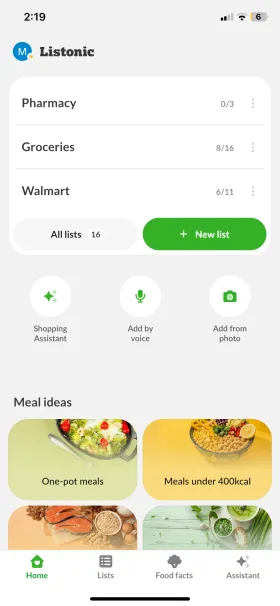
I see Listonic as more of a shopping-focused list app: get in, get the list right, get out efficiently, with an AI assistant available when you want meal-planning help too.
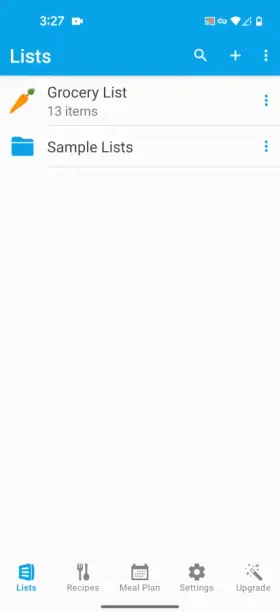
I see AnyList as more of a recipe-and-meal-planning app that also happens to make lists: plan the week, import recipes, and let the app build the shopping list from that plan. Both are legitimate approaches to the same problem; they just serve different habits.

Listonic
A fast, shopping-focused list app that also plans meals through its AI assistant
Strongest documented strengths: Free item photos, total cost tracking, custom categories, AI meal plans, 40+ languages

AnyList
A recipe-and-meal-planning-first app that generates lists from a weekly calendar
Strongest documented strengths: Recipe import, meal-planning calendar, cooking mode, Siri and Alexa support
Listonic wins on everyday shopping; meal planning is close
My short answer is that Listonic is the better overall pick for most people, because most people are shopping more often than they are planning a week of recipes [1, 3].
Recipes and meal planning is close enough to call a tie: Listonic’s AI assistant reaches a plan and a matching list in one step, while AnyList’s calendar and recipe-import system is more structured for a permanent recipe library. Everywhere else, Listonic’s speed, free-tier generosity, and simplicity add up to the stronger everyday app.
| Question | Better app | Why |
|---|---|---|
| Best overall grocery list app | Listonic | A broader free feature set and a simpler, faster everyday flow |
| Best for everyday grocery shopping | Listonic | Total cost calculation and item photos are free, and there is nothing to learn first |
| Best for meal planning and recipes | Listonic / AnyList | AnyList’s calendar and recipe import are more structured; Listonic’s AI assistant reaches the same plan and list in one step |
| Best for staying on budget for free | Listonic | Item prices and total-cost tracking cost nothing; AnyList gates the equivalent behind Complete |
| Best voice-assistant coverage | AnyList | Documented Siri Shortcuts and Alexa support, both on the free tier |
| Best free-tier value | Listonic | Photos, budgeting, custom sorting, and the web app are all free where AnyList charges for them |
| Easiest app to just pick up and use | Listonic | No recipe or calendar layer to learn before you can build a list |
What Listonic’s published data adds to the case
I do not want to rest this on opinion alone, and Listonic does have first-party signals that support the recommendation [1, 6].
- Budgeting
-
Users who track prices can spend up to 25% less on a weekly basis
One of the clearest product-outcome signals in the comparison
- Shared shopping
-
Users who share lists report fewer forgotten items and fewer duplicate purchases
Directly matches one of the most common household grocery problems
- Faster shopping
-
Shoppers with grocery lists spend an average of 23 minutes less time in stores
Explains why better list structure has a real-world payoff
- Repetition
-
About 70% of grocery-list items are repetitive
Justifies why history-based speed features matter so much
- Reach
-
10M+ Android downloads and 317K Android reviews, against AnyList’s 1M+ downloads and 30.3K reviews
A much larger, more battle-tested user base on Android specifically
- Review-base growth
-
About 10.5x more all-time Android ratings than AnyList, and a net increase of roughly 110,000 ratings since 2023 against AnyList’s 38,000
The ratings lead is not just larger, it is compounding faster too
How I evaluated these apps
I used a weighted editorial scoring model because this comparison is not a clean sweep in either direction, and the model keeps me honest about that [1, 3].
| Category | Weight | Listonic | AnyList |
|---|---|---|---|
| Speed & ease of use Grocery lists are repetitive. The faster the app gets you from idea to list, the more consistently you use it. | 15% | 9.0 | 7.4 |
| Real-time sharing A shared list only works if everyone sees the same thing without friction. | 15% | 8.8 | 7.8 |
| Recipes & meal planning For anyone who cooks from a plan rather than a memory, this is most of the value of the app. | 20% | 8.6 | 8.8 |
| Everyday shopping features Budgeting, photos, and product detail matter at the point of actually shopping. | 15% | 9.2 | 7.2 |
| Free version value Most shoppers will never pay for a grocery list app, so the free tier has to be genuinely usable. | 20% | 9.4 | 6.5 |
| Ratings & reviews Ratings at scale are the closest thing to a real-world track record. | 15% | 9.0 | 7.2 |
| Weighted total | 100% | 9.0 | 7.5 |
| Categories won | 6 | 5 | 1 |
Keep in mind
These are my own editorial scores, based on verified feature sets, official pricing pages, and live storefront data. They are not lab benchmarks. Recipes and meal planning is the one category where AnyList is genuinely ahead, and the score reflects that rather than smoothing it over.
Why you can trust this comparison
I built this article on official pricing and feature pages, not a skim of two app-store descriptions.
I went through Listonic’s and AnyList’s own product pages, AnyList’s help-center articles, and both apps’ current App Store and Google Play listings. Where a feature’s availability depends on which pricing tier you are on, I checked AnyList’s own features-comparison table row by row rather than trusting a summary of it [1, 3, 5, 6, 7].
This comparison also draws on a lighter review dataset than some of my others: a source comparison deck with review-mention counts and testimonial quotes for both apps, alongside the live storefront data I checked directly. Where a figure comes only from that deck, I say so rather than presenting it as independently verified.
That same deck points to a real difference in how actively each company manages its own reviews. Since 2023, Listonic’s team has replied to roughly 92% of its 1- and 2-star reviews, against 68-72% for AnyList, and typically did so faster too, with a median reply time of about 91 hours against AnyList’s 120. I read that as a genuine support signal, though, like the mention counts above, it comes from the deck rather than something I could re-verify against a live dashboard.
| Source type | What it was used for |
|---|---|
| Official product and features pages | Core feature claims, pricing tiers, and what is gated behind a subscription |
| App Store and Google Play listings | Ratings, review counts, downloads, and supported languages |
| AnyList help-center articles | Confirmation of specific integrations such as Siri |
| A source comparison deck | Review-mention counts and testimonial quotes for both apps |
At a glance
These profiles summarize the strengths, limitations, storefront signals, and positioning of both apps [1, 3, 5, 6, 7].
Listonic
20M+ downloads · 350K+ reviews
Best for
- Families and couples who want a fast, no-frills shared list
- Shoppers who want item photos and budget tracking without paying for them
Key pros
-
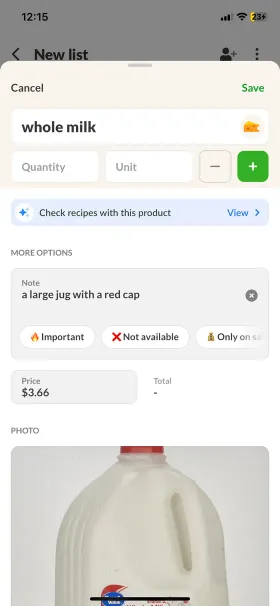
Total cost calculation, item photos, and custom categories, all free
-
No learning curve — the whole list and sharing flow stays simple
-
An AI assistant can still build a meal plan, just with less structure
-
Real-time list sharing for the whole household, with nothing about it held back for payment
Key cons
-
No documented Siri Shortcuts or Alexa support, unlike AnyList’s
AnyList
Best for
- Home cooks who import recipes and plan meals on a calendar every week
- Households who want unlimited recipe storage and a cooking-mode view
Key pros
-
A dedicated, drag-and-drop meal-planning calendar that generates a list automatically
-
Recipe import (5 free, unlimited on Complete), auto-combined ingredients, and a cooking-mode view
-
Documented Siri Shortcuts and Alexa support, both on the free tier
-
Leads clearly on iOS ratings, with a far larger ratings sample
Key cons
-
Item photos, budget tracking, the web and Mac apps, and Apple Watch all require the $9.99–$14.99/year Complete plan
-
The added recipe and calendar layers make it a harder app to just open and use for a simple list
-
Only 2 languages against Listonic’s 40+
What people say about both apps
Both apps have real, specific praise attached to them, not generic five-star noise [3, 5].
I love the real-time sharing feature and also the automated classification of items into categories.
This app does it all — loaded with features that are intuitive to learn and designed very well.
The numbers behind those impressions
Per the source comparison deck covering both apps, Listonic had more mentions of being “easy to use” (516 against AnyList’s 378) and “helpful” (97 against 84) in 2024, while AnyList had more positive mentions specifically about its premium features (30 against Listonic’s 21) — its Complete subscribers seem to feel they are getting real value for the subscription. The same deck’s topic analysis backs this up at scale. I have not independently re-derived these specific counts the way I have for live ratings and features, so treat them as directional rather than audited.
| Theme | Listonic | AnyList |
|---|---|---|
| Simplicity and ease | 35.0% | 33.4% |
The same theme on the complaint side runs the other way, which is the point: Listonic stays the simpler app even as its feature set grows.
| Theme | Listonic | AnyList |
|---|---|---|
| Simplicity and ease | 7.5% | 10.7% |
Why the choice depends on how you cook
The clearest reasons to pick Listonic cover most of what shopping actually involves; AnyList’s clearest edge is a dedicated recipe-and-calendar system for a permanent recipe library.
AnyList’s case is depth
Home cooks describe it as replacing scattered notes and bookmarked recipe sites entirely: import a recipe, tag it, and it lives in the app permanently. Planning a week of meals is a drag-and-drop exercise, dropping recipes onto a calendar that generates the shopping list automatically [3]. That entire calendar system, along with unlimited recipe import, requires AnyList Complete at $9.99 to $14.99 per year [3].
Listonic’s case is everything around the planning
It gives away item photos, total-cost calculation, and custom categories for free, where AnyList paywalls the equivalents. It also reaches far more people in their own language: 40+ languages against AnyList’s English and German [1, 7]. That reach shows up in the review data too: per the source comparison deck, Listonic’s review export spans 73 languages and carries a rating in 180 countries on Android, against AnyList’s 36 languages and 170 countries.
The one place AnyList pulls ahead that is easy to miss
It documents Siri Shortcuts and Alexa support, both on the free tier. I could not find equivalent official confirmation for Listonic, whose voice input is in-app dictation rather than an OS-level assistant integration [4].
Recipes and meal planning: a genuine tie
This is the closest category in the comparison, and I would call it a tie rather than default to Listonic.
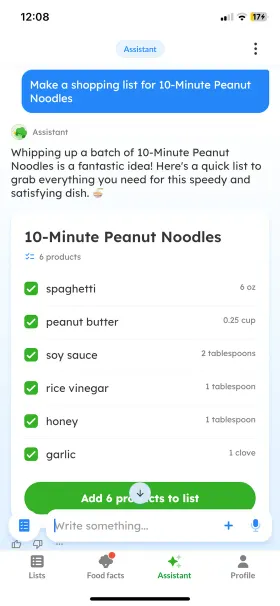
Listonic’s AI assistant can generate a meal plan and turn it into a shopping list in the same conversation, which is faster to start, needs nothing extra installed or learned, and still covers the core job: deciding what to cook and getting it onto a list [1].
AnyList’s recipe system is genuinely well built and trades speed for structure. Collecting and organizing recipes, adding ingredients straight to a list, and combining duplicate ingredients across recipes are all free. Recipe import from websites is free up to 5 recipes, unlimited on Complete. The meal-planning calendar itself, where recipes get dropped onto specific days and turned into a shopping list, is Complete-only [3]. What Listonic does not have is a permanent recipe library to browse back through.
Choose Listonic if you would rather ask for a plan when you need one and not maintain a recipe library at all. Choose AnyList if you already cook from a rotating recipe collection and want that collection to live in the app.

Speed & ease of use comparison
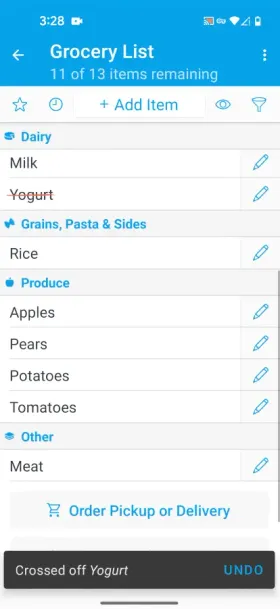
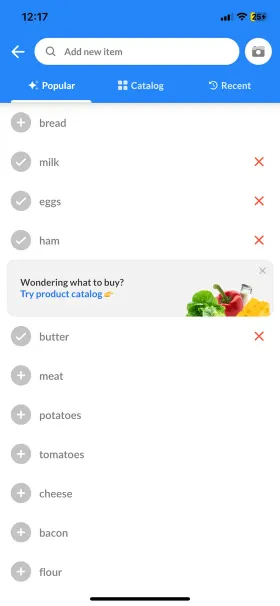
Listonic is easier for most people to start using because there is no recipe or calendar layer to learn before you can build a list [1, 3].
| Task | Listonic | AnyList | Winner |
|---|---|---|---|
| Build a fast list without planning ahead | Type or speak an item and it sorts itself by store section | Works the same way, with more menus around it | Listonic |
| Turn a week of recipes into a shopping list | The AI assistant turns a request straight into a plan and a matching list in one step | A drag-and-drop calendar is more structured, but takes more steps to reach the same list | Listonic |
| Track what the trip will cost | Item prices and a running total, free | Requires the Complete subscription | Listonic |
| Add items hands-free through a smart speaker | No documented Alexa or Siri integration | Documented Siri Shortcuts and Alexa support, both free | AnyList |
AnyList is not slow, but it is a more layered app by design: a full recipe-to-grocery-list tool, with recipe storage, meal planning, and calendar integration built in alongside the list itself. First-time users need real time to find their footing, and even experienced users can find it harder to locate a given setting than in a simpler app.
Pricing and free-version value
This is where the gap is widest, and it runs in Listonic’s favor [3].
Free on Listonic: item photos, total-cost calculation, custom categories, custom sorting, product suggestions, voice input, and the full web app. On AnyList, several of the equivalent features (item photos, budget tracking, the web and Mac apps, Apple Watch) sit behind AnyList Complete at $9.99 per year individually or $14.99 per year for a household. Listonic’s own paywall is narrower: mainly ad removal and deeper personalization.
| Pricing angle | Listonic | AnyList | My take |
|---|---|---|---|
| What you get without paying | Item photos, total cost calculation, custom categories and sorting, product suggestions, and the full web app | Lists, sharing, autocomplete, basic recipe collecting, and up to 5 recipe imports | Listonic’s free tier covers what most shoppers actually need; AnyList holds back photos and budgeting specifically |
| What the paid tier actually unlocks | Mostly ad removal and deeper personalization | The entire meal-planning calendar, unlimited recipe import, item photos, budget tracking, the web and Mac apps, and Apple Watch | AnyList Complete is doing far more work, because far more is held back for free users |
| Recipe depth for the price | AI-assisted meal plans included free, simpler and less structured | Unlimited recipe import and a full planning calendar for $9.99–$14.99/year | If meal planning is the whole point for you, AnyList’s subscription is arguably worth it |
Real-life shopping list workflows
When I map these apps onto real workflows, Listonic wins the shopping-focused ones and AnyList wins the planning-focused one.
Deciding what to cook for the week and shopping for it Listonic / AnyList
Listonic’s AI assistant covers this in one step: ask for a plan and get a matching list, faster to start and with nothing extra to set up. AnyList is better if you already keep a recipe collection: import recipes, drop them onto a calendar, and the shopping list builds itself, though it takes more steps to get there [3].
Staying on budget during the trip Listonic
Listonic is better here because item prices and a running total are free and visible the whole time you shop. The equivalent on AnyList requires Complete [1, 3].
Sharing the shopping with a partner Listonic
Both apps sync in real time once a list is shared, and neither gates the core sharing flow. Listonic’s edge is that nothing around sharing, like item photos or the total cost, is held back for payment either [1, 3].
Building a list from nothing, fast Listonic
Listonic’s flow stays a single layer deep: add an item, and it sorts itself. AnyList can do the same thing, but the app around it is built for recipes and planning first, so the fastest path is one menu further away [1].
Feature comparison table
Listonic covers more of the everyday shopping workflow for free; AnyList covers more of the recipe and meal-planning workflow for a price [1, 3, 4, 5, 6, 7].
| Feature | Listonic | AnyList |
|---|---|---|
| AI-assisted meal planning | Yes | No |
| Total cost calculation | Yes | No |
| Item photos | Yes | Partial Complete only |
| Item prices / budget tracking | Yes | Partial Complete only |
| Real-time shared lists | Yes | Yes |
| Dedicated meal-planning calendar | No | Partial Complete only |
| Custom categories | Yes | Yes |
| Custom sort order | Yes | No |
| Product / autocomplete suggestions | Yes | Yes |
| Voice input for adding items | Yes | Yes |
| Android home-screen widget | Yes | Yes |
| Web app | Yes | Partial Complete only |
| Languages | Yes 40+ | Partial English and German |
| Paid plan available | Yes | Yes $9.99–$14.99/yr |
| Recipe collecting | No | Yes |
| Cooking-mode recipe view | No | Yes |
| Amazon Alexa | No | Yes |
| Siri Shortcuts | No | Yes |
FAQ
Which app is better for everyday grocery shopping?
Listonic. It is built for the shopping trip itself: fast entry, automatic store-section sorting, free item photos and total-cost tracking, and real-time sharing with nothing held back for payment.
Which app is better for meal planning and recipes?
Close enough to call a tie. Listonic’s AI assistant turns a request into a meal plan and a matching shopping list in one step, faster to start and with nothing extra to learn. AnyList’s recipe import and drag-and-drop calendar are more structured for a permanent recipe library, but take more steps to reach the same list. Pick AnyList if you want that library; pick Listonic if you would rather ask for a plan when you need one.
Is Listonic’s free tier really comparable to AnyList’s paid tier?
In several ways, yes. Item photos, total cost calculation, and custom categories are free on Listonic and paywalled on AnyList behind its $9.99 to $14.99 per year Complete subscription. AnyList’s paid tier’s real value is its more structured meal-planning suite.
Which app has the better app-store rating?
It depends on the platform. On Google Play, Listonic leads at 4.7 against AnyList’s 4.5, with a far larger review base (317K against 30.3K). On the App Store, AnyList leads clearly at 4.9 against Listonic’s 4.7, also with a larger sample (80K against 10K).
Does either app support Siri or Alexa?
AnyList documents both, on its free tier. I could not find official confirmation that Listonic supports Siri Shortcuts or has an Alexa skill; its voice input is in-app dictation rather than an OS-level assistant integration.
The bottom line
Final verdict
Listonic is the more complete, more affordable app for everyday grocery shopping; meal planning and recipes is close enough to call a tie.
For day-to-day grocery shopping, which is what most people are doing most of the time, Listonic is the more complete, more accessible app, and its AI assistant still turns a plan into a list in one step for anyone who wants meal-planning help without the extra complexity. AnyList is a genuinely strong tool if your grocery list starts in the kitchen: plan meals for the week, import recipes, and let the app build your list from that plan. That depth is also its cost, since it is a harder app to navigate than Listonic, especially for anyone who just wants a shopping list [1, 3].
