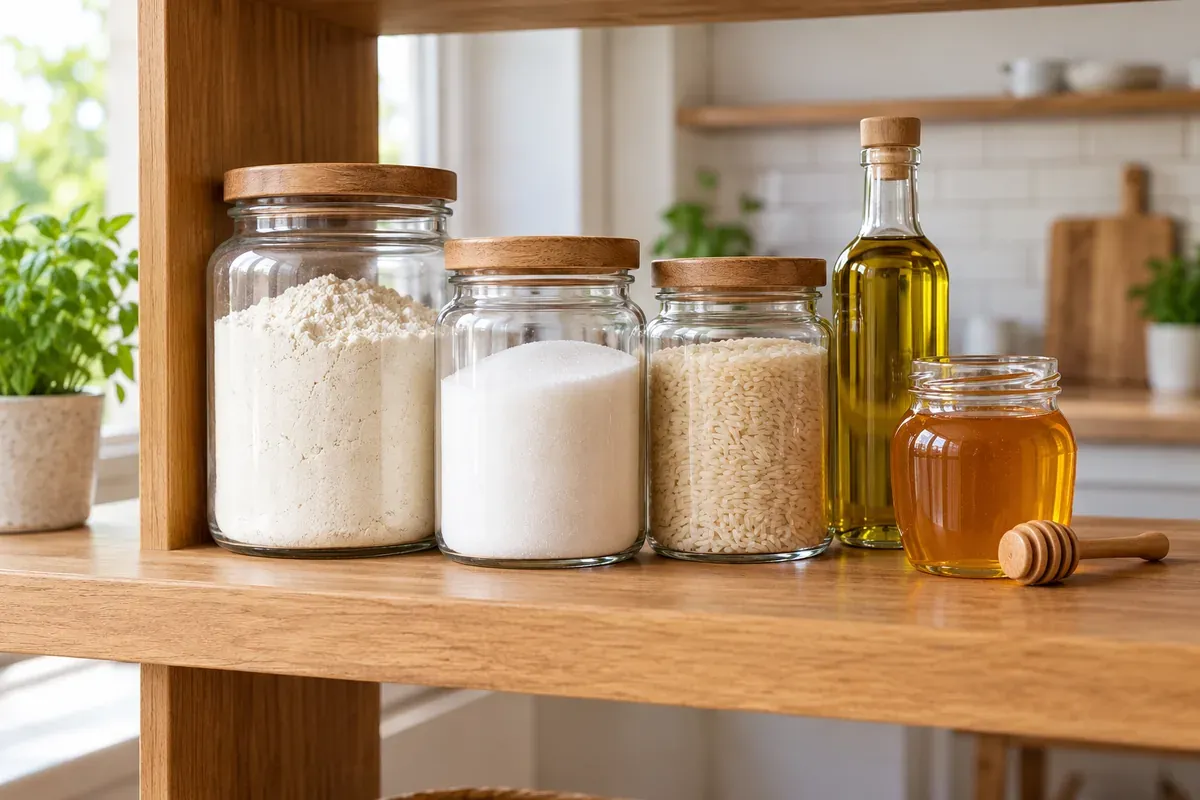
How long honey, flour, sugar, oils, and other pantry staples last
Quick answer
-
Room temperature
Keeps for 6-24 months
USDA FoodKeeper gives most staples 6 to 24 months in the pantry, while sugar, salt, and apple cider vinegar are listed as indefinite.
Watch out If a staple is covered with mold, throw it out and don't sniff it.
-
Fridge
Keeps for 4-18 months
Only a few staples use the fridge, with FoodKeeper times of 4 months for opened olive and vegetable oil, 1 year for opened white flour, and 18 months for opened balsamic vinegar.
Watch out Don't refrigerate coconut oil, because FoodKeeper says it makes it difficult to use.
Honey keeps its best quality for 12 months and stays safe after that, according to the USDA. FoodKeeper lists sugar, salt, and apple cider vinegar as indefinite. White flour lasts 6 to 12 months, and so do olive and vegetable oil. Many staples have a shorter time once opened, and the table lists both.
Buying pantry staples this week?
On a Listonic list, every item gets the amount you need and a note on when to use it by.
- Quantity and unit on every item
- A note like “fridge, use within a week”
- One list shared with everyone at home
Most pantry staples keep for months to years, and a few, like sugar and salt, are listed as indefinite. The times come from the USDA’s FoodKeeper app data. Honey keeps its best quality for 12 months and stays safe after that, and white flour gets 6 to 12 months.
Some FoodKeeper times count from the date of purchase, which is the day you bought the item. Others count from the day you open it. The table below lists both, and the sections after it cover each staple.
How long do pantry staples last?
Honey keeps its best quality for 12 months, white flour lasts 6 to 12 months, and sugar and salt last indefinitely. The table shows the pantry time and the time after opening for each staple.
| Staple | In the pantry | After opening |
|---|---|---|
| Honey | 12 months for best quality, safe after | Not listed |
| White flour | 6 to 12 months | 6 to 8 months in the pantry, 1 year in the fridge |
| Olive and vegetable oil | 6 to 12 months | 3 to 5 months in the pantry, 4 months in the fridge |
| Nut oils | 6 to 12 months | 3 to 8 months in the pantry, 6 to 8 months in the fridge |
| Canola oil | 1 year | Not listed |
| Sesame and avocado oil | 2 years | 6 months in the pantry |
| Coconut oil | 3 years | Not listed |
| Vinegar | 2 years | Not listed |
| Apple cider vinegar | Indefinitely | Not listed |
| Balsamic vinegar | 3 to 5 years | 18 months in the fridge |
| Granulated, brown, and confectioners sugar | Indefinitely | 18 to 24 months in the pantry |
| Salt | Indefinitely | Not listed |
| Baking powder | 6 to 18 months | 3 to 6 months in the pantry |
| Baking soda | 2 to 3 years | 6 months in the pantry |
| Cornstarch | 18 to 24 months | 18 months in the pantry |
| Pure vanilla extract | 2 years | 12 months in the pantry |
| Chocolate, solid unsweetened and semisweet | 1 to 2 years | 1 year in the pantry |
| Cocoa and cocoa mixes | Indefinitely | 1 year in the pantry |
| Chia seeds | 18 months | Not listed |
| Tea bags | 18 to 36 months | 6 to 12 months in the pantry |
| Loose tea | 2 years | 6 to 12 months in the pantry |
| Whole spices | 3 to 4 years | 3 to 4 years in the pantry |
| Ground spices | 2 to 3 years | 2 to 3 years in the pantry |
| Ready-to-eat cereal | 6 to 12 months | 2 to 3 months in the pantry |
| Oatmeal and other cereal you cook | 12 months | 6 to 12 months in the pantry |
Does honey go bad or expire?
Honey keeps its best quality for up to 12 months, and it’s still safe to eat after that. After 12 months the quality may not be as good, according to the USDA’s Food Safety and Inspection Service (FSIS). Treat 12 months as a quality guide, not a safety cutoff.
Is crystallized honey safe to eat?
Yes, crystallized honey is safe to eat. The USDA’s FSIS says honey can become cloudy, crystallized, or solidified, and that is not a safety problem.
How do you decrystallize honey?
Warm the honey in the microwave or in a pan of hot water to clear or melt it. The USDA’s FSIS names both ways for honey that has turned cloudy, crystallized, or solid.
Does honey need to be refrigerated?
No, USDA FoodKeeper lists honey for pantry storage and gives it no fridge time. If it turns cloudy or crystallized, that’s not a safety problem.
Does flour go bad?
White flour lasts 6 to 12 months in the pantry from the date of purchase, and 6 to 8 months after you open it. Opened white flour keeps 1 year in the fridge.
How long does whole wheat flour last?
Whole wheat flour keeps 3 to 6 months in the pantry, according to USDA FoodKeeper. Once opened, it keeps 6 to 8 months in the fridge.
How to store flour long term
For the longest storage, keep opened white flour in the fridge, where USDA FoodKeeper gives it 1 year. In the pantry, the same flour keeps only 6 to 8 months after opening.
Unopened white flour keeps 6 to 12 months in the pantry from the date of purchase. Whole wheat flour has shorter times, with 3 to 6 months in the pantry and 6 to 8 months in the fridge once you open it. FoodKeeper gives no freezer time for either flour.
Do oats, quinoa, and popcorn go bad?
Whole grain oats keep 4 months in the pantry, popcorn kernels in a jar keep 2 years, and uncooked quinoa keeps 2 to 3 years. Granola keeps 6 to 9 months, and store-bought breadcrumbs keep 6 months, according to USDA FoodKeeper.
Freezing doubles the time for oats. Whole grain oats keep 8 months in the freezer, and oat flour or meal keeps 4 months there instead of 2 in the pantry. Oatmeal, which FoodKeeper groups with cereal you cook, has a longer time, listed in the cereal and oatmeal section below.
Cooked quinoa keeps 6 to 7 days in the fridge and 6 to 12 months in the freezer. FoodKeeper gives uncooked quinoa a pantry time only.
Once you open a jar of popcorn kernels, they keep 1 year. Microwave popcorn packets last 6 to 12 months, and once popped they keep 1 to 2 days. Bagged popcorn that’s already popped lasts 2 to 3 months, or 1 to 2 weeks after you open the bag.
Regular degerminated cornmeal keeps 6 to 12 months in the pantry from the date of purchase. Stone-ground and blue cornmeal keep only 1 month there, and FoodKeeper doesn’t recommend the pantry once they’re open. After opening, they keep 2 to 4 months in the fridge.
| Food | In the pantry | Fridge, freezer, or after opening |
|---|---|---|
| Whole grain oats | 4 months | 8 months in the freezer |
| Oat flour or meal | 2 months | 4 months in the freezer |
| Uncooked quinoa | 2 to 3 years | Not listed |
| Cooked quinoa | Not listed | 6 to 7 days in the fridge, 6 to 12 months in the freezer |
| Popcorn kernels in a jar | 2 years | 1 year in the pantry after opening |
| Microwave popcorn packets | 6 to 12 months | 1 to 2 days once popped |
| Bagged popcorn, already popped | 2 to 3 months | 1 to 2 weeks after opening |
| Regular degerminated cornmeal | 6 to 12 months | 2 years in the pantry or 1 year in the fridge after opening |
| Stone-ground or blue cornmeal | 1 month | 2 to 4 months in the fridge after opening |
| Granola | 6 to 9 months | Not listed |
| Cereal and granola bars | 6 to 12 months | Not listed |
| Store-bought breadcrumbs | 6 months | Not listed |
Does cooking oil go bad?
Cooking oils last from 6 months to 3 years in the pantry, depending on the oil, according to USDA FoodKeeper.
Do olive oil and vegetable oil go bad?
Olive oil and vegetable oil share one FoodKeeper entry, with 6 to 12 months in the pantry from the date of purchase. After opening, they keep 3 to 5 months in the pantry or 4 months in the fridge.
Does coconut oil go bad?
Coconut oil lasts 3 years in the pantry. Skip the fridge and freezer, because FoodKeeper says refrigerating or freezing it makes it difficult to use.
How long do other oils last?
Canola oil lasts 1 year in the pantry from the date of purchase, and sesame oil and avocado oil last 2 years. Sesame oil and avocado oil keep 6 months in the pantry after opening.
Nut oils keep 6 to 12 months in the pantry from the date of purchase. After opening, they last 3 to 8 months in the pantry or 6 to 8 months in the fridge.
Does grapeseed oil go bad?
Grapeseed oil lasts 1 year in the pantry from the date of purchase, according to USDA FoodKeeper. That matches canola oil, and FoodKeeper lists no separate time after opening.
Does vinegar go bad?
Vinegar lasts 2 years in the pantry from the date of purchase, according to FoodKeeper. Apple cider vinegar and balsamic vinegar have their own entries.
Does apple cider vinegar go bad?
FoodKeeper lists apple cider vinegar as keeping indefinitely in the pantry.
Does balsamic vinegar go bad?
Balsamic vinegar lasts 3 to 5 years in the pantry from the date of purchase. After opening, FoodKeeper gives it 18 months in the fridge.
Does vinegar need to be refrigerated?
No, USDA FoodKeeper gives vinegar 2 years in the pantry from the date of purchase and lists no fridge time. Apple cider vinegar gets no fridge time either. Of the vinegars in this guide, only balsamic vinegar has one, 18 months after opening.
Does sugar go bad?
Sugar never spoils, according to USDA FoodKeeper, but for best quality you should use it within 2 years of opening. FoodKeeper lists granulated, brown, and confectioners sugar the same way, indefinitely in the pantry and 18 to 24 months after opening.
Does salt go bad?
FoodKeeper lists table, plain, or iodized salt in the pantry indefinitely.
Do black pepper, cinnamon, and nutmeg go bad?
Ground black pepper keeps 2 years in the pantry, and ground cinnamon and nutmeg keep 3 to 4 years, according to USDA FoodKeeper. All three times count from the date of purchase. Cracked black pepper lasts 2 to 3 years.
Cinnamon sticks are a whole spice, which FoodKeeper gives 3 to 4 years in the pantry. FoodKeeper says to keep jarred capers in the pantry until the package use-by date.
| Seasoning | In the pantry |
|---|---|
| Ground black pepper | 2 years |
| Cracked black pepper | 2 to 3 years |
| Ground cinnamon | 3 to 4 years |
| Ground nutmeg | 3 to 4 years |
| Capers in a jar | Until the package use-by date |
Do baking staples go bad?
Baking staples keep from 6 months to 3 years in the pantry, and baking powder has the shortest time.
Does baking powder go bad?
Baking powder lasts 6 to 18 months in the pantry from the date of purchase. After opening, the time drops to 3 to 6 months.
Does baking soda go bad?
Baking soda lasts 2 to 3 years in the pantry from the date of purchase, and 6 months after opening.
Does cornstarch go bad?
Cornstarch lasts 18 to 24 months in the pantry from the date of purchase, and 18 months after opening.
Does vanilla extract go bad?
Pure vanilla extract lasts 2 years in the pantry and 12 months after opening.
Do molasses, pancake mix, and marshmallows go bad?
Molasses lasts 1 to 2 years in the pantry from the date of purchase and 6 months after opening, according to USDA FoodKeeper. Pancake and biscuit mix keeps 9 months, and marshmallows keep 1 year unopened but only 1 month once opened.
Solid shortening keeps 1 to 2 years in the pantry from the date of purchase and 6 to 12 months after opening. Almond extract keeps the same time as pure vanilla extract, 2 years in the pantry and 12 months after opening.
Raisins and other dried fruit keep 6 months in the pantry from the date of purchase. Once opened, they last 1 month in the pantry or 6 months in the fridge, so the fridge is the better spot after opening.
| Item | In the pantry | After opening |
|---|---|---|
| Molasses | 1 to 2 years | 6 months in the pantry |
| Pancake and biscuit mix | 9 months | Not listed |
| Marshmallows | 1 year | 1 month in the pantry |
| Marshmallow crème | 2 to 5 months | 1 month in the pantry |
| Solid shortening | 1 to 2 years | 6 to 12 months in the pantry |
| Almond extract | 2 years | 12 months in the pantry |
| Raisins and other dried fruit | 6 months | 1 month in the pantry, 6 months in the fridge |
Does chocolate go bad?
Solid unsweetened and semisweet chocolate lasts 1 to 2 years in the pantry from the date of purchase, and 1 year after opening, according to FoodKeeper.
Does cocoa powder go bad?
FoodKeeper lists cocoa and cocoa mixes in the pantry indefinitely from the date of purchase, then 1 year after opening.
Do nuts and seeds go bad?
Yes, and most shelled nuts keep only 2 to 4 weeks in the pantry, according to USDA FoodKeeper. The fridge stretches that to 3 to 12 months, and the freezer to 9 to 24 months. Most of these times count from the date of purchase.
You can freeze walnuts and pecans for 24 months, the longest FoodKeeper time for either nut. For pine nuts, FoodKeeper suggests a plastic bag inside an airtight container in the freezer, where they keep 9 months.
Peanuts in the shell last longer at room temperature, with 4 months in the pantry. Once you open roasted peanuts, cashews, or almonds, they keep 1 to 2 weeks in the pantry or 4 weeks in the fridge.
Whole flaxseed keeps 2 years in the pantry, and FoodKeeper says the fridge and freezer aren’t necessary. Raw and roasted sunflower seeds keep 12 months, but roasted seeds turn rancid if they sit at room temperature for long periods.
| Nut or seed | Pantry | Fridge | Freezer |
|---|---|---|---|
| Pistachios, in or out of the shell | 3 weeks | 12 months | 24 months |
| Walnuts, in or out of the shell | 2 to 4 weeks | 9 to 12 months | 24 months |
| Pecans in the shell | 2 to 4 weeks | 12 months | 24 months |
| Shelled pecans | 2 to 4 weeks | 9 months | 24 months |
| Peanuts in the shell | 4 months | 12 months | 24 months |
| Shelled peanuts | 4 weeks | 12 months | 24 months |
| Shelled cashews | 2 to 4 weeks | 6 months | 12 months |
| Pine nuts | 2 to 3 weeks | 3 months | 9 months |
| Roasted peanuts, cashews, and almonds | Package use-by date, then 1 to 2 weeks after opening | 4 weeks after opening | Not listed |
| Raw unsalted sunflower seeds, shelled | 12 months | Not listed | Not listed |
| Roasted sunflower seeds, shelled | 12 months, then 3 to 4 months after opening | 7 to 8 months after opening | Not listed |
| Whole flaxseed | 2 years | Not necessary | Not necessary |
| Ground flaxseed | Not listed | 12 months | 12 months |
Do chia seeds, tea, spices, and cereal go bad?
These four have very different times, from 2 months for opened ready-to-eat cereal to 4 years for whole spices.
Do chia seeds go bad?
Chia seeds last 18 months in the pantry, according to FoodKeeper.
How long does tea last?
Tea bags last 18 to 36 months in the pantry from the date of purchase, and loose tea lasts 2 years. After opening, both keep 6 to 12 months. Matcha is the only tea FoodKeeper says you can freeze after opening.
How long do spices last?
Whole spices last 3 to 4 years in the pantry, and ground spices last 2 to 3 years. FoodKeeper gives the same time after opening, so opening doesn’t shorten either.
How long do cereal and oatmeal last?
Ready-to-eat cereal lasts 6 to 12 months in the pantry from the date of purchase and 2 to 3 months after opening. Oatmeal and other cereal you cook keep 12 months from the date of purchase and 6 to 12 months after opening.
Do dried beans, canned beans, and lentils go bad?
Dried beans last 1 to 2 years in the pantry from the date of purchase and 1 year after opening, according to USDA FoodKeeper. Dried lentils keep 1 year, opened or not.
Canned beans keep 2 to 5 years in the pantry from the date of purchase. FoodKeeper says canned items stay safe well past the use-by or best-by date as long as the can shows no dents, rust, or swelling.
Once you open a can of beans, keep them in the fridge, where they last 3 to 4 days. FoodKeeper doesn’t recommend storing opened canned beans in the pantry. Opened refried beans keep 2 to 3 days in the fridge, and unopened ones last 3 years in the pantry.
| Beans | In the pantry | After opening |
|---|---|---|
| Dried beans | 1 to 2 years | 1 year in the pantry |
| Dried lentils | 1 year | 1 year in the pantry |
| Canned beans | 2 to 5 years | 3 to 4 days in the fridge |
| Refried beans | 3 years | 2 to 3 days in the fridge |
What should you do with a moldy pantry staple?
Throw out any food that is covered with mold, and don’t sniff it, because that can cause respiratory trouble. The USDA’s guide to molds on food notes that molds tolerate salt and sugar better than most other food invaders.
Frequently asked questions
What does "from the date of purchase" mean on FoodKeeper?
A FoodKeeper time from the date of purchase counts from the day you bought the item. A time after opening counts from the day you open it.
Which pantry staples last indefinitely?
FoodKeeper lists sugar, salt, and apple cider vinegar in the pantry indefinitely. Cocoa and cocoa mixes are also indefinite from the date of purchase, then keep 1 year after opening.
Which pantry staples can go in the fridge?
FoodKeeper gives fridge times after opening for a few staples, including 4 months for olive and vegetable oil, 1 year for white flour, and 18 months for balsamic vinegar. It advises against refrigerating coconut oil.
Can you freeze tea?
Matcha is the only tea FoodKeeper says you can freeze after opening. Bagged and loose tea keep 6 to 12 months in the pantry after opening.
Can you sniff a pantry food to check for mold?
No. The USDA says not to sniff a moldy food, because it can cause respiratory trouble. If a food is covered with mold, throw it out.
Is cloudy honey safe to eat?
Yes. The USDA's FSIS says honey can become cloudy, crystallized, or solidified, and that is not a safety problem.
Can you microwave crystallized honey?
Yes. The USDA's FSIS says honey can be warmed in the microwave or in a pan of hot water to clear or melt it.
Does molasses need to be refrigerated?
No. USDA FoodKeeper lists molasses for the pantry, where it keeps 1 to 2 years unopened and 6 months after opening, and gives it no fridge time.